Sofa Circuit: Why Britain’s Most Exciting Gigs Are Happening at Someone’s House
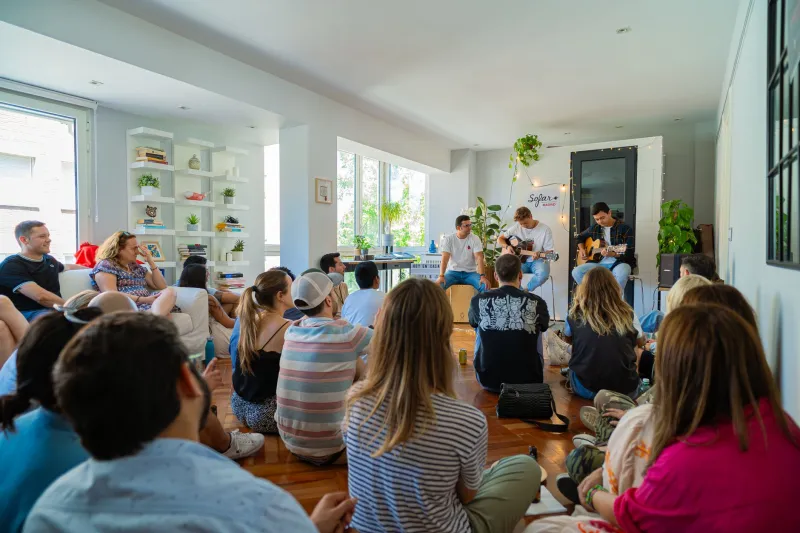
On a Thursday in Leeds, 28 people are sitting cross-legged on a living-room floor while a singer tests a borrowed amp. The bar is a cool box by the radiator. The toilet queue is the stairs. The tickets went out by email three weeks ago and sold out in 40 minutes. Nobody is checking their phone, because the room is too small to hide in and the set is too new to Shazam.
This is the sofa circuit: a loose, word-of-mouth network of micro-gigs in flats, record shops, church halls, community centres and the occasional back room of a pub. It is not a new idea — house shows have been part of DIY music for decades — but in 2026 it is becoming something broader and more mainstream-adjacent. The appeal is not just cheap tickets. It is the feeling of being somewhere that could not exist at scale.
The venue is a postcode
The first thing to understand about these nights is that the address is the aesthetic. A 400-cap venue can absorb a bad sound mix. A living room cannot. Everything is exposed: the squeaky floorboard, the neighbour’s dog, the fact that the headline act is standing next to you in the kitchen eating crisps. That exposure is the point. You are not watching a show from a dark huddle at the back; you are in the room with it.
Record shops have been quick to lean into this. A shop floor after hours, with the racks pushed to the walls and a lamp borrowed from the back office, makes a surprisingly good venue. So does a church hall with its stackable chairs and tea urn. The common thread is not the building type but the cap on capacity. Thirty people is a party. Three hundred is a crowd. The atmosphere changes when everyone can see everyone else’s face.
What a cool box tells you
The cool box bar is the tell. If you arrive and see a plastic tub of tinnies with an honesty box, you are in the right place. These nights are cost-conscious by design — not in a grim way, but in a practical one. Venue hire is low or nonexistent, marketing is a mailing list, and the money goes to the artist rather than a bar operator. Tickets are often £8–£15, and the merch table is a towel on a chair. For audiences feeling the squeeze of big-night economics, that matters. But it is not the whole story.
What people seem to be buying is unpredictability. The set list is not a greatest-hits run-through. Artists try new material, switch instruments, bring on a friend. Sometimes it works. Sometimes it really does not. Either way, you leave with a story and a sense of having been early to something. In a culture of algorithmic recommendations and polished touring productions, a 30-person room is one of the few places left where you can still be surprised by a night out.
How to find the sofa circuit
There is no central box office, which is part of the charm and part of the friction. The best routes in are still human. Start with independent record shops — many run mailing lists and pin flyers by the till. Follow the venues and promoters you like on social media, but expect the useful information to arrive by email rather than feed. Word of mouth remains the strongest signal. If a friend says they are going to a gig in a flat in Bristol, ask if there is space.
Cities with strong DIY and community music networks — Manchester, Glasgow, Sheffield, London, Cardiff, Belfast — tend to have the densest activity, but the circuit is not urban-only. Church halls and community centres in smaller towns are hosting some of the most interesting nights precisely because they are not on the usual touring route. The trade-off is that you have to be willing to travel to a postcode you have never been to before, and to trust that the address is real.
The etiquette bit
A living-room gig only works if everyone agrees to be a good guest. Arrive when the doors say, not when the headliner starts. Bring cash for merch. Do not treat the host’s home like a venue with staff. If there is a cool box, put your money in it. If there is a neighbour who has agreed to tolerate 30 people singing along, leave quietly. The social contract is simple: respect the room, and the room keeps happening.
For hosts, the calculation is a little more involved. Insurance, noise, capacity, and the awkward question of whether to ask for help with costs all come up. Many organisers keep things small on purpose — not because they lack ambition, but because the intimacy is the product. A gig for 30 people is not a failure to scale. It is a different format entirely.
Why now
In 2026, the big night out is expensive, logistically annoying and often strangely impersonal. The small night out is none of those things. It is also more local, which fits the wider mood: people want their culture to happen near where they live, not after a train ride and a booking fee. The living-room gig is not replacing the arena. It is filling a gap the arena cannot reach — the gap between a night in and a night out, where the stakes are low, the music is live, and the bar is a cool box by the radiator.
If you have not been to one yet, start small. Find a record shop with a noticeboard. Join a mailing list. Say yes to the friend with the flat and the borrowed amp. The best seat in Britain might just be someone’s sofa.