Someone Else's Shelf: The Quiet Thrill of Buying a Book With a Past
There is a particular kind of British Saturday that ends in a charity shop, rain on the window, and a paperback you did not plan to buy. You open it on the bus home and find a name in blue biro: 'To Elaine, Christmas 1994, from Auntie Jean.' Underneath, in a different hand, a single line: 'Read this on the train to Carlisle. Cried. You will too.' Suddenly you are not just holding a novel. You are holding a small, accidental piece of someone else's life.
The archive nobody meant to build
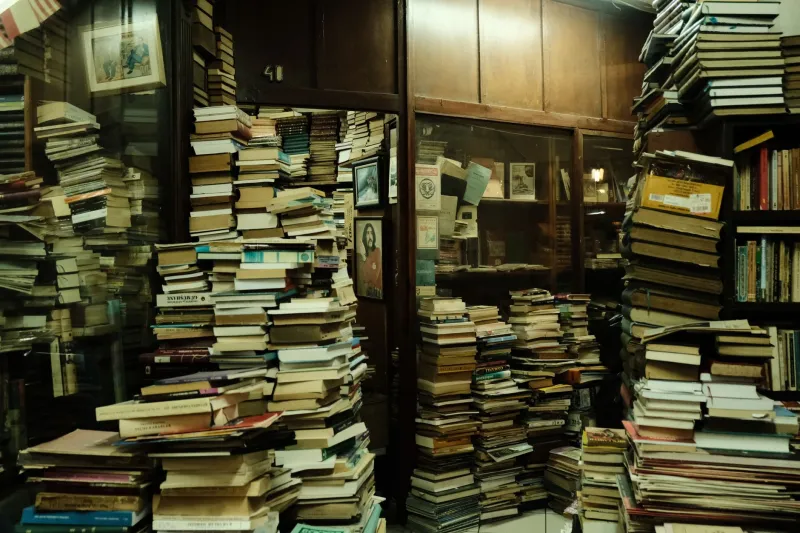
Britain has an extraordinary number of places where old books wash up. Oxfam bookshops, British Heart Foundation shelves, church hall sales, car boot tables, the stacked corners of provincial auction rooms, the open-air bookshops of Hay-on-Wye. Most of the volumes are ordinary: spy thrillers, cookery manuals, holiday reads, textbooks that outlived their syllabus. But open enough of them and a pattern emerges. These are not just cheap copies. They are containers.
Inside, you find pressed train tickets from British Rail, a faded receipt from a Boots that no longer exists, a handwritten recipe for flapjack on the back of an envelope, a child's drawing of a dog. You find dedications that range from the formal ('With best wishes for your birthday, 1978') to the cryptic ('For the other one'). You find marginalia: asterisks, underlinings, disagreements in pencil. One reader argues with a novelist across three decades. Another has corrected the grammar of a much-loved author, which feels either brave or rude depending on your mood.
The point is not that every second-hand book is a treasure. It is that the ordinary ones are quietly doing something unusual. They are preserving the everyday, which is exactly what official archives tend to miss.
Why the margins are having a moment
Second-hand bookshops have always had their devotees. What feels different in 2026 is the way younger readers are talking about them. The appeal is not only price, though price matters. It is not only sustainability, though that matters too. It is the sense that a used book has a texture a new one cannot fake. In an age of clean digital text and algorithmic recommendations, a pencilled note in the margin feels almost rebellious. It is evidence of a human being, reading slowly, in a particular place, at a particular time.
There is also a practical thrill to the hunt. Charity shops are unpredictable by design. You cannot search their shelves from your sofa. You have to turn up, rummage, and accept that most of what you find will be forgettable. That is part of the charm. The occasional find — a 1960s Penguin with a stranger's holiday address inside, a hardback inscribed on a wedding day, a guidebook annotated by someone who actually went — lands differently because you did not order it.
And there is a growing language around it. Booksellers talk about 'association copies' when a book is connected to a notable owner. The rest of us are simply learning to check the endpapers first, before we check the price.
How to read a book's leftovers
The first rule is to slow down at the point of sale. Most people flip to the title page and then to the blurb. Instead, open the front cover. Look at the inside of the dust jacket. Check the half-title. That is where inscriptions live. Then fan the pages. A pressed flower will fall out. A bus ticket will slide sideways. A shopping list will remind you that someone once needed milk and cat food on the same day they were reading this.
Marginalia is more divisive. Some readers cannot bear it; they want a clean text and no interruptions. Others find it companionable. My own rule is simple: if the notes are in pencil and the book is cheap, buy it. If the notes are in ink and the book is expensive, think about whether you want the conversation. A good second-hand bookshop will often price an annotated copy lower, which is a mistake if the annotations are the reason to buy it. But it is also a small mercy for the curious.
The ethics of someone else's story
There is a line between curiosity and intrusion. A name in a book is not an invitation to look someone up. The fact that a volume has ended up in a charity shop does not mean its previous owner wants to be found. Treat inscriptions as you would treat a letter left on a park bench: read it if it is open, but do not pocket the envelope and go knocking on doors.
That said, there is a growing trend of books being returned to families when the connection is obvious and the book is clearly significant. Booksellers sometimes post about it. Readers sometimes reunite a wartime diary or a childhood favourite with a relative. These stories are lovely precisely because they are rare. The everyday case is quieter: a book moves on, carrying its marks with it, and the next reader adds nothing except their own attention.
A shelf that talks back
What makes this distinctly British is not the sentimentality. It is the modesty of the thing. Nobody is claiming that a charity-shop paperback is a national monument. It is just a book, on a shelf, with a bit of someone else in it. But that bit is enough to change the reading experience. You notice a sentence differently because a stranger underlined it in 1983. You pause at a chapter break because someone else stopped there too.
So next time you are in a charity shop and the rain is coming down, spend five minutes on the paperback table. Open a few covers. Read the dedications. Check for tickets. You are not just buying a cheap read. You are browsing an archive that nobody meant to build, and that is still being added to, one forgetful reader at a time.